
Sliding gates and swing gates are both popular choices across Perth households, but what is the right choice for your driveway?
While personal preference for looks can be an important factor, your property layout and budget can ultimately determine your final decision. Therefore, it’s important to understand how they work and what to consider before making your choice.
In this article, we’ll compare sliding gates and swing gates to help you determine which option best suits your home.

What’s the difference between a swing gate and a sliding gate?
The main difference when choosing between sliding or swing gates is how each opens. Swing gates open inward or outward on hinges like a standard door, using a single leaf or a double-leaf setup, whereas sliding gates move horizontally along a ground track or cantilever system parallel to your fence line.
Swing gates need plenty of space to open and close without being affected by any obstacles or sloped driveways, making them more suitable for longer driveways with sufficient depth and clearance.
Sliding gates can be a more practical option for properties with shorter or sloped driveways, provided there is enough room alongside the driveway for the gate to slide open.

Considerations when comparing sliding gates to swing gates
How much space do you have?
The amount of space available on your property is an important factor when choosing between a sliding gate and a swing gate.
Single swing gates need the depth behind or in front of the gate equal to 100% of the gate’s width. There should also be ample space for the hinge or motor clearance, requiring at least 100mm on either side.
By comparison, sliding gates don’t require any room for swing distance and instead need enough lateral space along the fence line to open fully. This typically makes sliding gates ideal for short driveways with plenty of room along the fence line, and swing gates the best option for narrow frontages with a long, clear driveway.
Is your driveway flat or sloping?
The choice between sliding and swinging gates can also be determined by whether your driveway is flat or sloping and in which direction. An uphill or downhill slope can cause a gate to scrape the pavement or leave a large gap underneath.
If you have a driveway that slopes up or down from the street, your best option is usually a sliding gate, as they handle gradients and uneven ground easily because they move level across the opening. However, a slope along the fence line can make sliding gates more difficult to install and operate, so in this scenario, swing gates may be the easier option.

What material should I choose?
Your choice of material for your sliding or swing gate can be down to aesthetic appeal; however, it’s also important to consider strength, durability and maintenance requirements.
Aluminium
Aluminium gates are considered the most popular choice for Perth driveways as they are strong, durable and very low-maintenance, representing great value over time. Their resistance to rust and corrosion makes them great for wet weather conditions and houses in coastal locations. Aluminium is also very malleable, making it easy to shape into intricate designs and decorative patterns.
Steel
If you need extra security for your gate, steel would be the best option due to its exceptional strength. Steel gates are extremely difficult to cut, warp, break through, or force open. Steel can also be welded and shaped into sleek modern slats, solid panels, or ornate traditional patterns, which allows for a range of different designs.
The drawback of steel is that it’s a heavier and more expensive material and requires stronger hinges and posts. Steel can be prone to rust if its protective coating is damaged, so a high-quality powder-coated finish is important to help protect against corrosion and extend the gate’s lifespan.
Powder-coating
If you want to extend the longevity and further protect the condition of your gate, investing in a high-quality powder-coating treatment can prove very beneficial.
At Fencemakers, we use an advanced maxicoat powder-coating technology, backed by a specialist five-stage pre-treatment process, on all products we manufacture. Steel products undergo a multi-stage zinc phosphate pre-treatment, while aluminium products receive a chromate pre-treatment to help the powder-coating bond more firmly to the surface, for a longer-lasting finish.
Our advanced powder-coating process exceeds 1,000 hours of salt-spray testing, offering up to 10 times the testing performance of many other powder-coating methods.
Timber
Natural timber gates are a visually appealing option, but require ongoing maintenance, including sanding, oiling and painting. Timber gates are also more prone to rotting and warping, as wood is more vulnerable to UV, weather and pest damage. A great compromise is wood-look aluminium gates, which are more durable and require less maintenance without sacrificing the visual appeal of natural timber.

Manual or automatic operation?
Manual gates
The main advantage of a manual gate is its affordability and straightforward maintenance. Without an electric motor or automated components, manual gates generally have lower upfront costs and are often easier and less expensive to repair if a hinge, latch or other component wears out. They also operate without electricity, meaning power outages won’t affect their use and there are no ongoing electricity costs.
However, the biggest drawback of a manual gate is the inconvenience of operating it. Every time you enter or leave your property, you’ll need to stop your vehicle, get out to unlock and open the gate, drive through, then close and secure it behind you. This can become frustrating during heavy rain, late at night or when you’re in a hurry. Manual gates may also be less practical for households with frequent vehicle movements or multiple people coming and going throughout the day.
Automatic gates
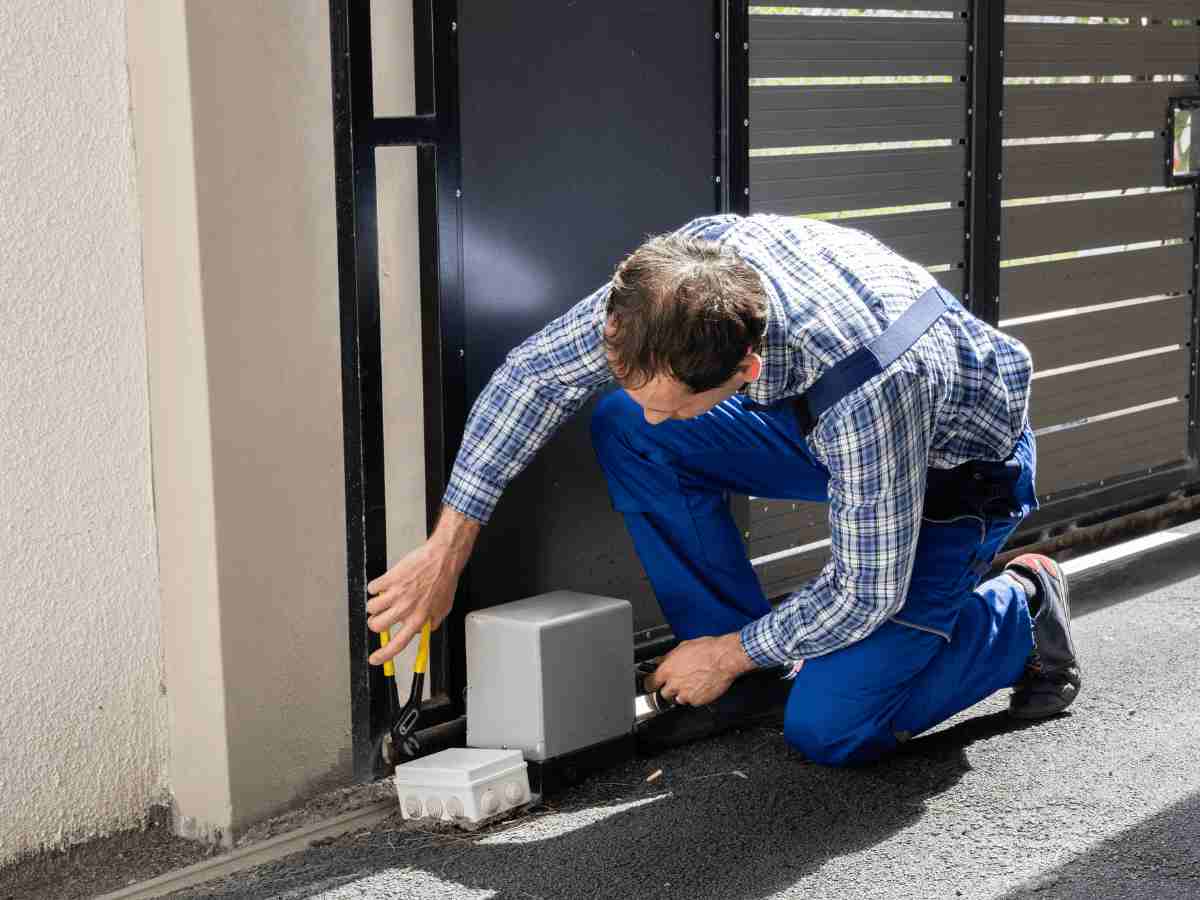
One of the biggest advantages of an automatic gate is convenience. With a remote control, keypad or other access system, you can open and close your gate without leaving your vehicle. Automatic gates can also improve security by controlling access and, depending on the motor and locking mechanism, making the gate more difficult to force open manually.
However, automatic gates generally have higher upfront costs due to the motor, access controls and installation requirements. They also rely on a power supply to operate, so it’s worth considering a battery backup or manual release mechanism to ensure you can still access your property during a power outage.
The right choice will depend on your budget, security needs and how frequently you use your gate. Below, we compare the key differences between manual and automatic mechanisms for both sliding and swing gates.
What is the difference in price?
Gate costs vary depending on size, design, material, installation requirements, and whether it is a manual or electric gate.
Fencemakers offer a wide range of gates in different styles and materials for Perth households. Our friendly team can arrange an on-site consultation to assess your property, discuss your requirements and help you find the right gate to suit your driveway, budget and security needs.

Which gate is right for your property?
| Feature | Manual Swing Gate | Manual Sliding Gate | Automatic Swing Gate | Automatic Sliding Gate |
|---|---|---|---|---|
| Operation | Requires physical effort to operate by swinging by hand. | Requires physical effort to operate by sliding by hand. | Hands-free operation via remote, sensor, keypad, or smartphone app. | Motorised operation via remote, sensor, keypad, or smartphone app. |
| Initial cost | Lower initial cost but can cost more in long-term repairs and additional parts. | More cost-effective as it only requires the gate panel, track, wheels, and basic hardware. | Higher cost as it requires a motor, wiring, safety sensors, and professional installation. | Higher cost as it requires a motor, wiring, safety sensors, and professional installation. |
| Space requirements | The depth behind or in front of the gate needs to be equal to 100% of the gate’s width. At least 100mm on either side is required for hinge clearance. | Needs enough lateral space along the fence line to open fully. | The depth behind or in front of the gate needs to be equal to 100% of the gate’s width. At least 100mm on either side is required for motor clearance. | Needs enough lateral space along the fence line to open fully. |
| Maintenance | Low maintenance required as it needs periodic hinge lubrication or alignment. | Only requires track clearing and wheel lubrication. | Requires periodic motor calibration and electrical checks. | Requires periodic motor calibration and electrical checks. |
| Convenience | Less convenient due to manual opening and closing time. | Less convenient due to manual opening and closing time. | Remote access allows for convenient entry and exit. Dependent on power supply, making it inconvenient during power outages. | Remote access allows for convenient entry and exit. Dependent on power supply, making it inconvenient during power outages. |
| Security | Variable security, as it relies entirely on manual padlocks or latches. | Variable security features and relies on physically locking a latch or padlock. | Great security features available, including automatic locking, encrypted access codes, and optional intercoms. | Great security features available, including automatic locking, encrypted access codes, and optional intercoms. |
Swing vs Sliding Gate – The final verdict
Still unsure whether a sliding gate or swinging gate is the right choice for your driveway?
The friendly team at Fencemakers can help you find the best solution for your property, taking into account your available space, budget and security needs. Contact Fencemakers today to arrange your free measure and quote, and let our team help bring your ideal driveway gate to life.